MOVA
AI-Powered Personal Finance Platform
MOVA brings accounts, investments, insurance, loans, and financial goals together in one connected view, helping people understand their complete financial position. With AI-powered insights and guided actions, MOVA makes managing finances simpler and more proactive—while keeping every important decision under the user’s control.
Product UI & Experience


Designing an AI-Powered Financial Companion
Exploring how contextual AI can connect financial information, surface meaningful insights, and help people make informed financial decisions.
Project type
Self-initiated product concept
Focus
Product framing, information architecture, user flows, interaction design, UI design, AI interaction patterns, and prototyping.
Status
Concept and prototype
Role
End-to-end Product Designer
Platform
Digital financial management experience
Design Pillars
Connected Finances
Contextual AI Assistance
User-Controlled Automation
Overview
MOVA is a self-initiated concept exploring a more connected way to understand and manage personal finances. It brings together accounts, investments, insurance, loans, financial goals, and automated money-management rules in one experience.
The concept explores how contextual AI could help people interpret their financial information, understand relevant insights, and consider potential next steps. Rather than treating AI as a standalone chatbot, MOVA integrates assistance into the financial experience while keeping users in control of consequential decisions.
The project brings together product thinking, information architecture, end-to-end workflows, interface design, and AI interaction design in a single product concept.
My finances are spread across several accounts: my salary account, spending account, savings account, mutual fund account, home loan account, and car loan account.
Every month, when my salary arrives, I manually check balances across these accounts, calculate how much I need for everyday spending, loan repayments, bills, and savings, and transfer money from my salary account to the relevant accounts. I then update an Excel sheet to keep track of my overall financial position.
The problem doesn't end there.
My finances change throughout the month. A coffee with friends, a restaurant visit, an unexpected expense, or a newly generated electricity bill can change my available balance and upcoming financial commitments. Keeping my spreadsheet accurate means repeatedly checking accounts and updating the figures manually.
Paying bills adds another layer of friction. I have to switch between different apps and services to manage payments, while my overall financial picture remains spread across different places.

"
I spend too much time managing my financial information instead of using it to make better financial decisions
The Problem
I manage my money across multiple accounts, apps, and spreadsheets.
Why can't I manage everything in one place?
The Opportunity
What if all my finances worked together in one place?
I envisioned MOVA as an AI-powered personal finance platform that connects my financial accounts, brings my complete financial position into one view, and helps simplify the everyday work of managing money.
With MOVA, I want to:
See everything together
Understand my overall financial position across bank accounts, savings, investments, loans, bills, and financial goals without manually consolidating everything in a spreadsheet.

Make financial management simpler
Understand how much money is available, what needs to be set aside, and how upcoming bills and financial commitments affect my plans.
Stay on top of changing finances
Bring transaction updates, changing balances, upcoming bills, and financial commitments into a connected view, reducing the need to maintain everything manually.
Automate repetitive tasks
Configure AI agents to handle predefined tasks, such as allocating my salary across spending and loan accounts when my salary arrives, subject to account permissions and appropriate safeguards.
Make more informed financial decisions
Ask MOVA questions such as, "I have ₹10,000 available. What investment options should I consider?" and explore options based on my financial goals, time horizon, and risk tolerance.
One complete picture of my finances. Less manual work. Smarter financial decisions with AI working according to my rules and me always in control.
Product Vision

Core Design Principles
One complete financial picture
Bring accounts, balances, spending, investments, loans, bills, and goals into one connected view.
Design implication:
Unified dashboard and financial summaries.
1
2
AI that understands financial context
Help people interpret their financial position, explore options, and understand the implications of potential decisions.
Design implication:
Contextual AI assistance and relevant financial insights
3
Automate repetitive work
Let users configure rules and AI agents for recurring tasks instead of repeatedly doing the same work manually.
Design implication:
Automation setup, triggers, rules, and execution status.
4
Keep financial information current
Help users understand their latest available balances, transactions, and upcoming commitments without relying on manual spreadsheet updates.
Design implication:
Transaction history, upcoming bills, data freshness, and update states.
5
Keep the user in control
Make AI recommendations understandable and automated actions configurable, transparent, and appropriately authorised.
Design implication:
Unified dashboard and financial summaries.
Sitemap
MOVA’s information architecture brings the platform’s core financial capabilities into a clear, connected structure. The sitemap organises primary navigation, supporting pages, and AI-powered features around users’ everyday financial tasks—from understanding their complete financial position to managing accounts, tracking commitments, exploring financial goals, and configuring automations.
This proposed structure establishes a scalable foundation for the MOVA experience while keeping AI-driven actions transparent and users in control.

User Flows
Mapping the key financial journeys
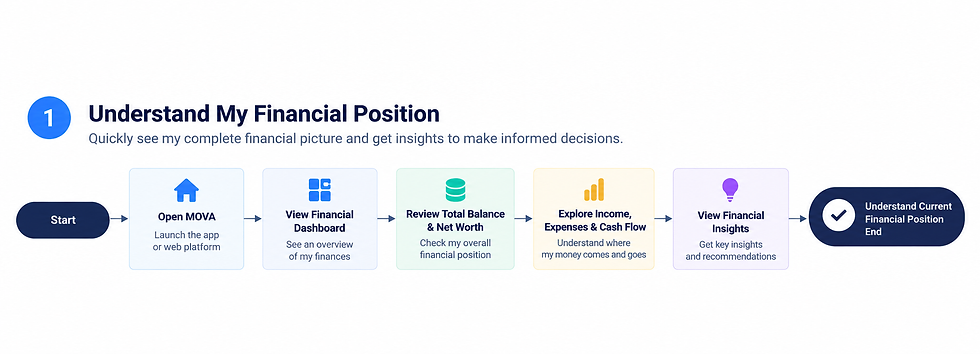
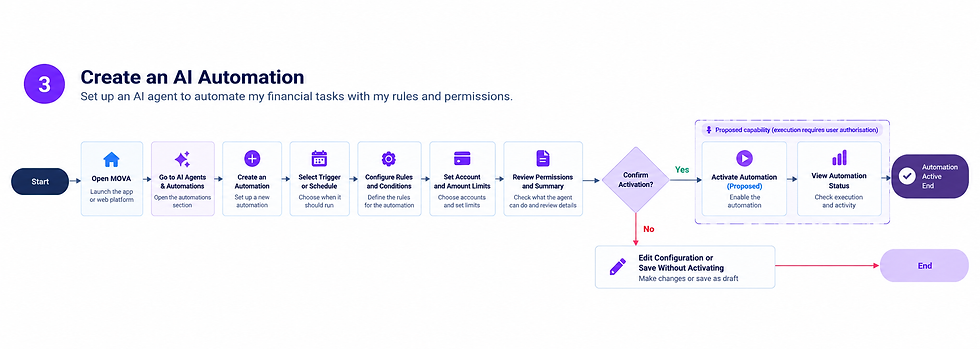
With the information architecture defined, I mapped three core user journeys to understand how users navigate MOVA, complete key tasks, and interact with AI-powered capabilities.
The flows focus on three scenarios: understanding the user's financial position, managing an upcoming bill, and creating an AI automation. Each journey outlines the key steps, decisions, and outcomes while highlighting where user review and control are essential.
The three journeys
-
Understand My Financial Position — Explore financial information and insights through the dashboard.
-
Manage an Upcoming Bill — Review bill details and follow the proposed payment journey.
-
Create an AI Automation — Configure rules, review permissions, and decide whether to activate an automation.
These flows established the foundation for the subsequent wireframes and interface design.

Wireframes
Defining structure before visual design
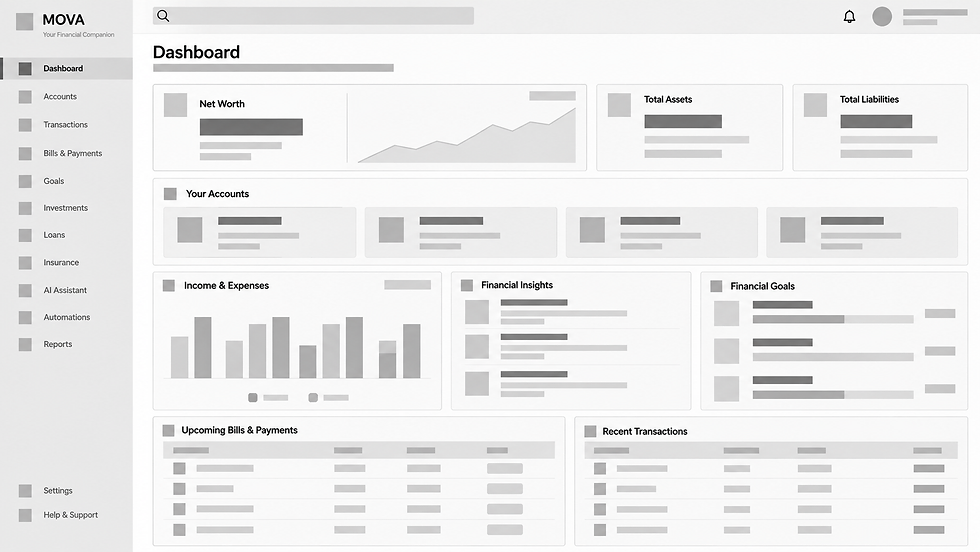
I translated the MOVA concept into a low-fidelity dashboard wireframe to define the information hierarchy, content grouping, and layout before applying the final visual design.
The dashboard brings key financial information into one workspace, helping users understand their financial position and access important activities without navigating between multiple sections.
Key structural decisions
-
Financial overview: Prioritises net worth, total assets, and total liabilities at the top of the dashboard.
-
Account visibility: Groups connected accounts into a single section for quick reference.
-
Financial understanding: Organises income and expenses, financial insights, and goal progress into distinct content areas.
-
Everyday financial management: Places upcoming bills and payments alongside recent transactions for easy access.
-
Consistent navigation: Uses a persistent sidebar to connect the dashboard with accounts, investments, loans, insurance, goals, the AI assistant, and automations.
This wireframe established the dashboard's foundational structure and content hierarchy, providing a starting point for the high-fidelity interface design.
Visual Design & UI Experience
Translating structure into a cohesive financial experience
With the information architecture, key user flows, and dashboard wireframe established, I moved into visual design to create a clear, consistent, and approachable financial management experience.
The interface brings together complex financial information through structured layouts, clear visual hierarchy, and reusable UI patterns. The design prioritises readability, easy navigation, and quick access to essential financial information while giving AI-powered assistance and automation a clear place within the experience.
The goal was to make managing multiple aspects of personal finance feel more connected, understandable, and easier to navigate.
Explore the interactive prototype to experience MOVA's key screens and financial journeys.
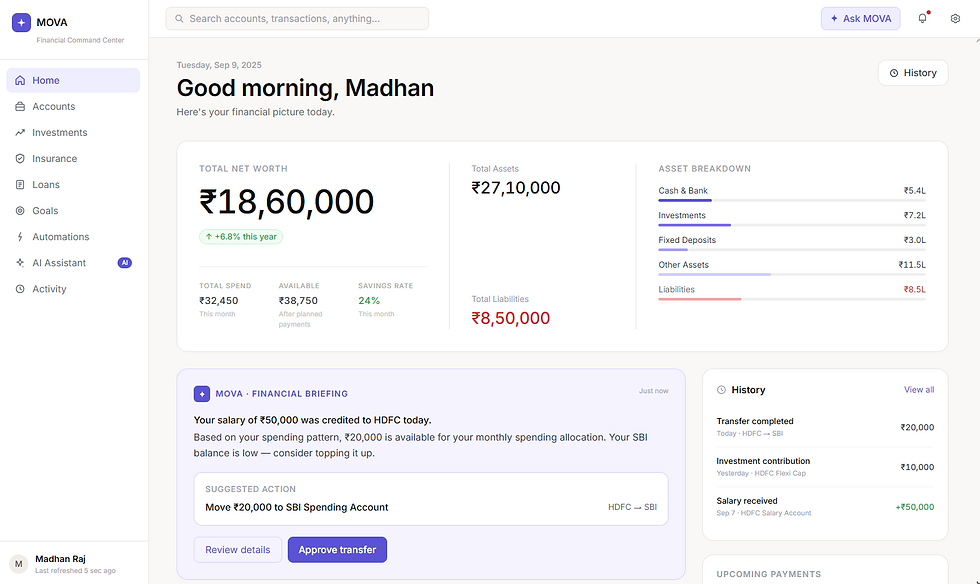
A unified view of the customer's financial life across bank accounts, investments, liabilities, goals and AI-driven recommendations.
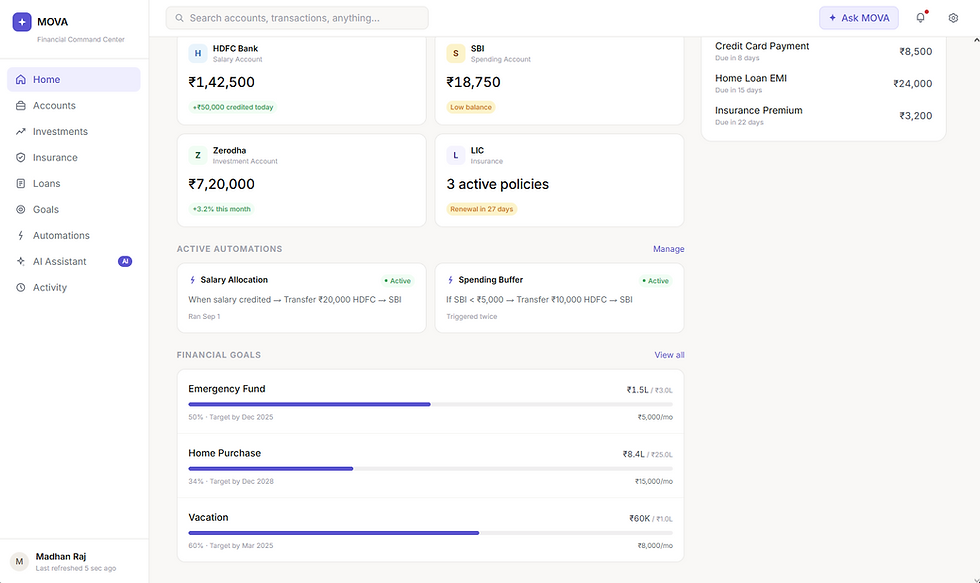
Quickly understand connected accounts, upcoming payments, active automations and progress toward financial goals in one place.

A transparent history of transactions, automations and AI-driven recommendations, giving users a clear record of what happened and when.
A unified view of the customer's financial life across bank accounts, investments, liabilities, goals and AI-driven recommendations.
Key Design Decisions & Learnings
Designing for clarity, connection, and user control
1. Bring the complete financial picture together
I prioritised a unified dashboard that brings net worth, accounts, income, expenses, financial goals, and upcoming payments into one view. The intention was to reduce the effort required to understand an individual's overall financial position.
3. Make complex information easier to scan
I used clear visual hierarchy, grouped content, and distinct sections to make financial information easier to navigate and understand.
2. Organise information around user needs
The sitemap and user flows helped structure MOVA around key financial tasks, from reviewing financial information to managing bills and configuring automations.
4. Keep AI actions under user control
The proposed automation journey includes configuration, permission review, and confirmation, reinforcing the importance of transparency and user authorisation in financial experiences.
Key Learnings
Working on MOVA reinforced my belief that personal finance should feel like one connected experience rather than a collection of separate tools. It also highlighted the importance of designing AI-powered experiences that make proposed actions understandable while keeping users in control of consequential decisions.